Packaging faces the regulatory challenge: five projects show how to turn circularity from regulation into practice
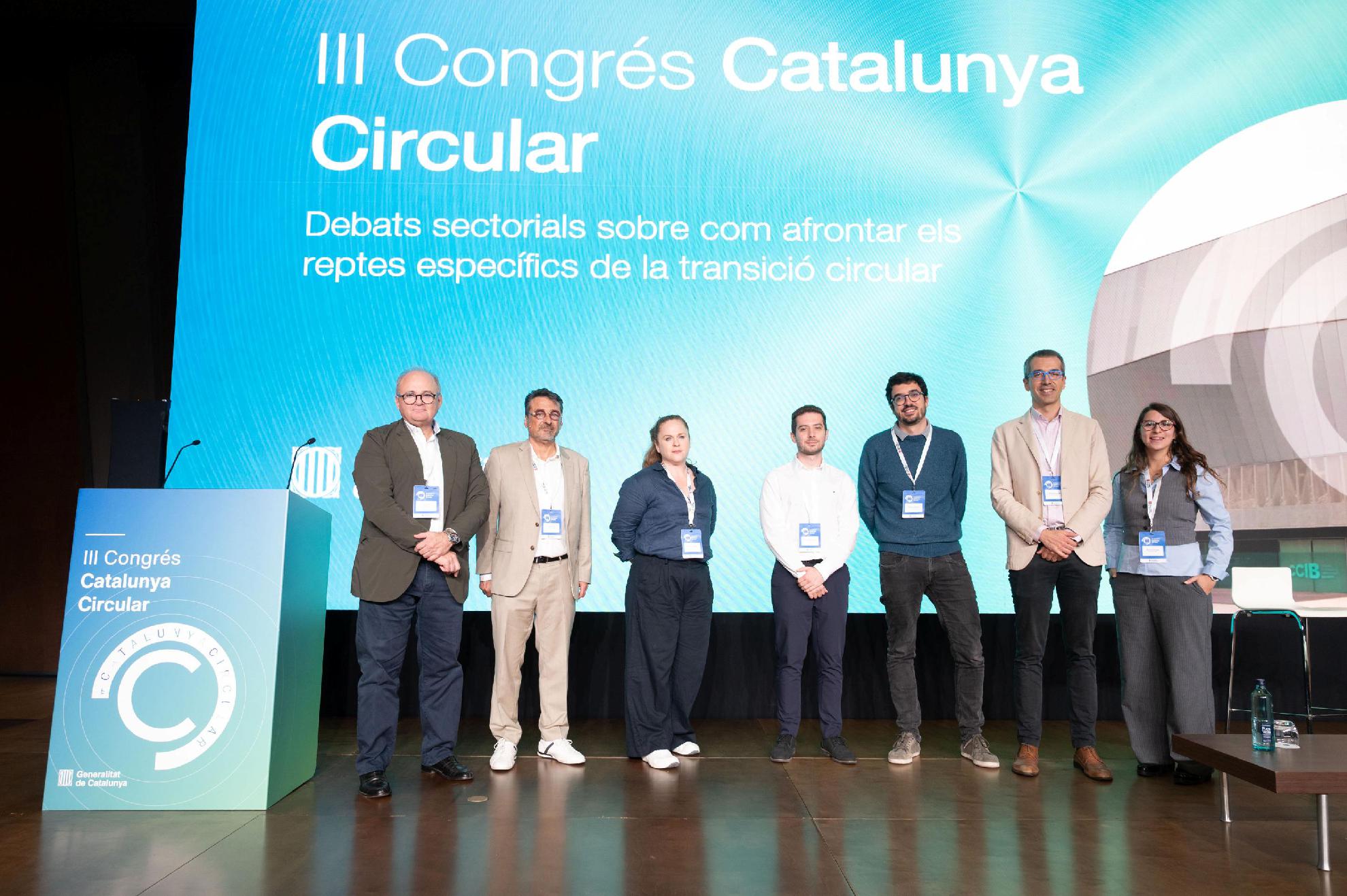
New European regulations on packaging, reuse, recycling, traceability and digital information are transforming the packaging industry. To explore how businesses can address these changes in practice, Packaging Cluster organised the session “Circular Packaging and Legislation: From Regulation to Practice” as part of the 3rd Catalunya Circular Congress, held at the Barcelona International Convention Centre (CCIB). The session was moderated by Mercè Gorina, Head of Innovation and Projects at Packaging Cluster, who led the different presentations and activities throughout the session.
The session, held on 29 October, combined regulatory insights, participatory activities and presentations of business and technology projects. Its aim was to connect regulatory requirements with solutions that are already being developed to help companies move towards more circular packaging models.
The 3rd Catalunya Circular Congress concluded this edition with 1,631 attendees, 113 speakers and the participation of 352 companies and organisations, consolidating its position as one of Spain’s leading events on the circular economy.
Five regulations, five challenges for industry
The session was structured around five regulatory areas that will shape the sector’s future: the European Packaging and Packaging Waste Regulation (PPWR), with a particular focus on reuse and recycling; the European Union Deforestation Regulation (EUDR); deposit return systems (DRS); and the Digital Product Passport (DPP).
Each section began with an introduction and a participatory activity to identify the main challenges involved in implementing each regulation. Jordi Julian, Director of Strategy and Business Development at ECOTIC, provided the regulatory context and helped connect regulatory requirements with businesses’ needs.
Against this background, five projects and solutions showcased different ways of anticipating regulatory changes and incorporating circularity into product and packaging development.
Reuse: rethinking packaging as a system
The first section, dedicated to the PPWR and reuse, featured the project 2IN1EFLAT, presented by Martí Rovira from Capsa2in1. The initiative proposes a reusable packaging system for technological products, an area in which product protection and packaging characteristics are particularly important.
The project, which has the support of the Waste Agency of Catalonia, exemplifies the need to go beyond the substitution of materials and rethink the packaging system, incorporating reuse from the design phase.
Recycling: making material recovery easier
Improving recyclability was the focus of the second section, also linked to the PPWR. Daniel Márquez from Leitat presented DesLamTin, a project focused on the delamination and deinking of flexible packaging to facilitate recycling. The project has the support of the Waste Agency of Catalonia and the collaboration of IFLEX.
The initiative addresses one of the sector’s technical challenges: recovering materials from multilayer structures and improving their potential for recovery and valorisation. Developing technologies that make it possible to separate and recover these materials is an important step towards more recyclable packaging and more efficient resource use.
Traceability: new tools to verify product origin
The third section addressed the European Union Deforestation Regulation (EUDR). In this context, Pepe Costa presented Retexcycle, a solution to facilitate product traceability.
The proposal highlights the importance of having mechanisms in place to identify materials and track their journey, a growing need in response to new requirements for transparency and supply chain oversight.
Deposit return systems: ecodesigning products beyond return schemes
The session also explored deposit return systems (DRS), with a presentation of the PET360 project by Victòria Ferrer from the Gremi de Recuperació de Catalunya.
The project focuses on the ecodesign of PET products that are not included in the DRS and explores how their design can be improved by taking into account their management and recovery at the end of their useful life. This approach broadens the perspective on PET circularity beyond products covered by return schemes.
Digital Product Passport: technology connecting information and products
The final section focused on the Digital Product Passport (DPP) and the role of digital technologies in improving information and traceability. Lluís Quintana from Thinex presented a solution based on printed electronics, incorporating traceability features and biosensors capable of detecting product conditions.
These technologies open up new possibilities for connecting digital information with physical products and facilitating their tracking throughout the value chain.
From regulatory requirements to business innovation
The five initiatives presented during the session show that adapting to new European regulations does not depend on a single technology or a universal solution. Reuse, material recovery, traceability and digitalisation are complementary areas that require innovation, expertise and collaboration among the different stakeholders across the value chain.
Through this session, Packaging Cluster sought to bring the regulatory framework closer to the realities of businesses and showcase projects that are already working to turn regulatory challenges into opportunities for innovation. This highlights that the transition towards circular packaging is not simply about complying with new obligations, but also about developing technological solutions and new design models that can help build a more efficient and competitive industry.